
Mr. Popper’s Penguins Unit Study for Elementary
Mr. Popper’s Penguins is a Newberry Honor book by Richard and Florence Atwater and is beloved by millions of children. This children’s novel is about a house painter and his penguins and will have you and your family laughing throughout the read aloud and learning activities!
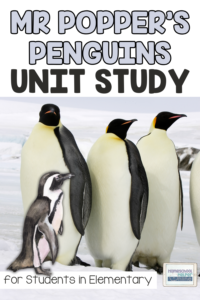
This literature-based penguins unit study has Language Arts, history, and STEM activities to go along with each chapter of Mr. Popper’s Penguins. Learn about penguins, famous explorers, letter writing, and more!
I recommend reading the book aloud together as a family. It will be more fun to experience the antics of Mr. Popper and his penguins together.
As you read each chapter in the book, complete the activity listed for the chapter.
Some links in this post may be affiliate links. This means that if you click on them, I may make a tiny commission, at no extra cost to you. For more info, check our privacy policy.
Resources for your Mr. Popper’s Penguins Unit Study
1 Mr. Popper’s Penguins by Richard and Florence Atwater Get the ebook version if you have Hoopla, or for free from Open Library
2. Penguins! by Gail Gibbons
3. A non-fiction book about weather, such as My First Book About Weather (Dover Science For Kids Coloring Books) by Patricia J. Wynne or use our Weather Lapbook.
4. Select at least one of these non-fiction books about Antarctic explorers:
- Black Whiteness: Admiral Byrd Alone in the Antarctic by Robert Burleigh Find the ebook version at Open Library for free
- Trapped by the Ice!: Shackleton’s Amazing Antarctic Adventure by Michael McCurdy
- Ernest Shackleton: Going South: Heroes of History by Janet and Geoff Benge (I recommend the audiobook version which is on Hoopla)
- Captain Cook: The Great Ocean Explorer (What’s Their Story? series) by Haydn Middleton
- Sailing the Unknown by Michael J. Rosen (for your younger elementary kids) Also on Open Library
- or Polar Explorers for Kids: Historic Expeditions to the Arctic and Antarctic with 21 Activities by Maxine Snowden Also on Hoopla
5. Pick one of these non-fiction books about Adelie penguins (all of the good ones are OOP, but you can look for a used copy of one of these, or grab one from your local library:
- A Penguin Year by Susan Bonner
- Birds of Antarctica: The Adelie Penguin by Jennifer Owings Dewey
6. The March of the Penguins 2005 Rated G
7. Penguins Playlist from Nat Geo Kids to research the different traits of each species
Activities for Mr. Popper’s Penguins Unit Study:
Chapter 1: Mr. Popper is an outdoor house painter and will have no more work until the weather warms up in the spring. The Popper family is going to have to economize on their meals. Have the children plan an economical menu by using weekly grocery ads and coupons. Use the Budget Meal Planner worksheet included in the new Mr. Popper’s Penguins Unit Study bundle.
Tip: Older, vintage cookbooks are a great place to find economical meals, like an old vintage copy of the Better Homes and Gardens cookbook. I also have liked every recipe I’ve tried over at Eating on a Dime.
Chapter 2: Mr. Popper wrote a letter to the explorer Admiral Drake. Have the children find out who Admiral Drake was. They can use the Sir Francis Drake notebooking pages to look up and record information about him. Have them write a friendly letter to a friend or relative. (Both of these resources are included in the new Mr. Popper’s Penguins Unit Study bundle)
Chapter 3: Mr. Popper receives a penguin from Admiral Drake. Have the children research the different species of penguins to figure out what species Mr. Popper’s penguin is, based on the description given. Have your kids fill in the Mystery Penguin worksheet in the new Mr. Popper’s Penguins Unit Study bundle.
Next, have each child choose a species of penguin they would like to study. Print out the Penguin Species Worksheet for each child for them to fill in as you progress through the rest of the book. Have each child draw a picture of the penguin they researched.
Chapter 4: The Poppers try to figure out what Captain Cook, their penguin, likes to eat. Have the children research what their penguin species likes to eat.
Chapter 5: Mr. Popper has the icebox fixed for Captain Cook’s house. Have the children research the habitat of their penguin species. Plot out on a map where their penguin species lives. Also, plot where other penguins live. See if they can figure out what all of these places have in common.
Chapter 6: Mr. Popper must look into the proper licensing for having a penguin. Have children look into your state or town’s licensing requirements for pets and especially exotic pets. Would they need a special license to have a pet penguin?
After this unit, your kids may want to learn more about other exotic pets with our sister site’s Small and Exotic Pets Unit Study
Chapter 7: Captain Cook builds a nest. Have the children research the nesting and breeding habits of their penguin.
Chapter 8: Mr. Popper is interviewed by a newspaper reporter. Have the children pretend they are the reporter and write the newspaper article using the information from Mr. Popper’s interview. Make sure they include the answers to What? Why? When? Where? and How?
Chapter 9: Captain Cook takes Mr. Popper on a toboggan ride down a set of stairs. Watch a video of penguins tobogganing and discuss with them why they think penguins do this instead of walking sometimes.
Compare and contrast penguins with birds that live near your home and with puffins. Use the Penguins v. Puffins and Penguins v. Local Birds Venn diagram worksheets (included in the new Mr. Popper’s Penguins Unit study bundle).
Chapter 10: Captain Cook the penguin is acting ill, so Admiral Drake sends another penguin, Greta. Read “A Penguin Year” by Susan Bonners.
Complete one of the Penguin Word Searches: Species and Life Cycle (included in the new Mr. Popper’s Penguins Unit study bundle).
Chapter 11: While they have the windows open, a blizzard occurs, leaving piles of snow in the house. Use the snow notebooking page to write about blizzards (included in the new Mr. Popper’s Penguins Unit Study bundle). They could include an official definition of a blizzard, recent notable blizzards, consequences of blizzards, or tell about a blizzard that they experienced.
Chapter 12 & 13: There is a lot of concern in these two chapters about the Popper’s finances. This is a good opportunity to talk about good financial management. Have your kids first make a list of the things your family spent money on this past week. Now, have them write beside each item how much it cost and whether it was a “want” or a “need”. Have them make a total of the wants and a total of the needs. Use the Wants v. Needs worksheet in the new Mr. Popper’s Penguins Unit Study bundle. Talk with them about where you could have saved money as a family. Could you have purchased some of the items second hand? Or waited for it to be on sale?
Along with your kids, make a budget for next month and let them help you stick to it. Use the Budget worksheet in the new Mr. Popper’s Penguins Unit Study bundle.This will help them to see how much things really cost.
If you have time, you could have your student complete this Money lapbook or you could just select a few activities out of it. The following activities from the money lapbook: credit and debit, budget activity, stretch your dollar, and ways to make money, are all appropriate to these two chapters.
Print out the How to Make Change Worksheet and let your kids practice making change from different dollar amounts. (This is included in the Mr. Popper’s Penguins Unit Study bundle.) I laminated our worksheet so they could reuse it a couple of times every week until they were confident with their skills.
Chapter 14: In order to make money to pay for all of the penguin expenses, the Popper family starts a penguin show. Have the children put on their own penguin show using penguin puppets made from small paper lunch bags or stick puppets (included in the new Mr. Popper’s Penguins Unit Study bundle).
Chapter 15: The penguins perform to Schubert’s “Military March”, Lehar’s “Merry Widow Waltz”, and “By the Brook”. Listen to these pieces in piano. Have the children make up another act for the penguins to perform and choose music for it. If you want, you could even let them use the Canva app to make a video of animated penguins dancing to the music.
Chapter 16: The Poppers travel by train. Learn more about steam train travel. Be sure to learn about the different types of cars and the train employees. Use the Steam Engine: Trains notebooking pages and resources to have your student write what they learned about trains.
Chapter 17: Mr. Popper gives a testimonial for Owen’s Oceanic Shrimp in exchange for free shrimp for the penguins. Have the children draw how they think the magazine ad would look. Use the Owen’s Oceanic Shrimp worksheet or a large sheet of card stock or construction paper, be sure to include the quote or testimonial from Mr. Popper.
Chapter 18: Mr. Popper’s performing penguins encounter some show seals. Why would the penguins be upset at encountering seals? Have the children research what the natural predators are for their species of penguin. Then, watch this Seal and Sea Lion show.
This book uses a lot of alliteration: Popper’s Performing Penguins, Marvelous Marcos, Owen’s Oceanic Shrimp, and Swenson’s Seals. Let the children try to come up with their own examples of alliteration or use the Mr. Popper’s Penguins Alliteration worksheet to write and draw their example (included in the new Mr. Popper’s Penguins Unit Study bundle).
Chapter 19: Mr. Popper has a big decision to make. Using the Mr. Popper’s Dilemma printables, (included in the new Mr. Popper’s Penguins Unit Study bundle) have the student make a list of the pros and cons of each choice and decide which one they think is the better choice. Have them write a persuasive essay to Mr. Popper telling him which he should choose.
Chapter 20: The Popper’s have traveled to Seattle, Minneapolis, Milwaukee, Chicago, Detroit, Cleveland, Philadelphia, Boston, and New York. In Chapter 20, Mr. Popper, the children, and the penguins set off to the North Pole from New York with Admiral Drake. Trace their route on a map.
Use the Penguin Notebooking pages to record what you’ve learned about penguins, or to write your own penguins story (included in the new Mr. Popper’s Penguins Unit study bundle).


Other fun educational penguin ideas:
Have the children try to walk like penguins. Feed them goldfish crackers as they “Ork”
Try a new fish entree for dinner. My kids love frozen salmon fillets, baked with a pat of butter and cajun seasoning or Old Bay seasoning sprinkled on top before baking in the oven alongside a baked sweet potato.
Read Psalm 50:10-11.
Make a Penguin Small World to play with using small plastic penguins like the ones in this Antarctic Penguins TOOB and a small tub or bin. We used scraps of old white Styrofoam packing (from a printer box), small blue glass gems from the floral department of the dollar store, and some of the fake snow made from baking soda and hair conditioner (find the Fake Snow directions here at our sister site). Since Styrofoam floats, you could even add water (if you leave out the fake snow) and pretend the Styrofoam pieces are floating ice.
Go to a zoo that has penguins. If your local zoo doesn’t have a penguin exhibit, watch the live stream of the penguins at the St. Louis zoo.
Your upper elementary age children might enjoy the movie “8 Below” 2006 Rated PG. This Disney live-action movie is about eight sled dogs and their driver surviving the conditions in the Antarctic, as well as Antarctic explorers and scientists.
Learn more about Antarctica with our Antarctica Lapbook.

Download your copy of the OLD, ORIGINAL Mr. Popper’s Penguins Unit Study from the Free Resource Library. Look under Unit Studies or GRAB THE NEW, COMPLETELY UPDATED VERSION FROM THE HHO SHOP.


Don’t forget to pin this to your favorite Pinterest board so you can find it again later.
And be sure to follow Homeschool Helper Online on Pinterest for 1000s more free homeschooling resources!

