Little House: Sugar Snow Unit Study for PreK-2nd Grades
This literature unit is based upon the My First Little House Book: Sugar Snow by Laura Ingalls Wilder and is perfect for late wintertime learning with your younger kids.

In this Sugar Snow Unit Study, your kids in PreK-2nd grade will learn all about the maple syrup (sugarmaking) process, maple tree identification, and much more with these multi-subject hands-on lessons and activities.
Some links in this post may be affiliate links. This means that if you click on them, I may make a tiny commission, at no extra cost to you. For more info, check our privacy policy.
Resources for your Sugar Snow Unit Study
Required Resources:
Sugar Snow My First Little House Book by Laura Ingalls Wilder
Sugarbush Spring by Marsha Wilson Chall
From Maple Tree to Syrup by Melanie Mitchell (or similar non-fiction title)
Fun With Nature (Take-Along Guide) by Boring, Burns, and Dendy (We have used this book throughout our homeschooling journey, and it and its sequel, More Fun with Learning, are books that your kids will use over and over!)
The Sugar Snow Printable Pack (see below)
Out of Print Books that are Worth the Search
The Maple Syrup Book by Marilyn Linton
The Missing Maple Syrup Sap Mystery by Gail Gibbons
Extra Books to Read Just for Fun
The Sugaring-off Party by Jonathan London A French-Canadian look at maple sugaring
Maple Sugarin’ in Vermont: A Sweet History by Betty Ann Lockhart For parents interested in learning more, this half story, half non-fiction book is packed with North American sugaring history.
My Little House Cookbook by Barbara M. Walker
Online Resources: Maple Trees
Maple tree identification at Leafy Place
Identify maple trees by their leaves with Vermont Evaporator
Identifying and tapping Maple Trees from Barkleyvale Farms
ID a maple tree and make maple syrup at Souly Rested
Online Resources: Maple Syrup & Candy
How Maple Syrup and Maple Snow Candy are made with Squad Quad.
Directions from the Little House on the Prairie website on making Maple Candy
Video from EmmyMade on making Sugar Snow Maple Candy just like Mary and Laura
Sugar Snow Unit Study Lessons & Activities
Science
Maple Trees
- Read about maple trees on pages 252-253 in Fun With Nature or use the online resources.
- Go for a nature walk to locate maple trees. If you are looking in late winter, before the buds have opened, you can identify a maple by its bark, seed pod “helicopters”, and its characteristic “eye to eye” leaf growth.
- Use crayons to make a bark rubbing on your Maple Tree Identification Journal page in the Sugar Snow Printable Pack.
- Color or draw pictures of maple leaves, seedpods or maple trees in your tree journal.
- Find all of the maple leaves on the Maple Leaf Identification journal page in the Sugar Snow Printable Pack
Maple Syrup
- Watch the Squad Quad video (above) about the process of sugarmaking & maple syrup. Discuss with your kids.
- Compare the 1800’s methods in the book Sugar Snow to the more modern methods in Sugarbush Spring.
- Complete the Sugar Snow Then and Now Worksheet in the Sugar Snow Printable Pack
- The sap is usually running from the maple trees by the end of February, and if you happen to live in an area with deciduous (leaf-losing) trees, you may find a local nature center that does maple-tapping demonstrations.
Snow
- Snow is formed when ice crystals in a cloud bump together and stick to each other. If the temperature of the air below the cloud is cold enough, snow falls. Watch this video from Ask Dr. Universe first, and then the time-lapse video of forming snowflakes.
- All snowflakes have six sides, but no two snowflakes are just alike. Have your children cut paper snowflakes making sure no two are the same. If you aren’t sure how to fold your paper to create a six-pointed snowflake, follow these directions from Fantasvale Art Lab.

Social Studies & History
Pioneer Life
- This story is based on the childhood of Laura Ingalls in the 1870’s. Point out the pictures of the log cabin, clothing, open fire, and punched tin lantern, and candlelight.
- Discuss the pastimes the Ingalls family had, the girls playing paper dolls, Pa whittling wood, Ma sewing. Compare them to the pastimes your family members have. Would your child enjoy living as a pioneer, without television, or electronic games, no cars or telephones or running water?
- If you use a timeline in your homeschool, add a picture of the Sugar Snow book cover from the Sugar Snow Printable Pack.
Geography
- Laura lived in the Big Woods of Wisconsin. Show your child on a United States map where Wisconsin is, and identify the state as being in the northern part of the United States, close to Canada. Canada’s flag has a maple leaf to show the importance of sugarmaking in the north. Use the Sugar Snow Geography worksheet in the Sugar Snow Printable Pack to show where Wisconsin and Canada are located on the North American continent map.
- You can also use the Sugar Snow Geography worksheet to color in every state where maple syrup is produced. (Answer: Every US state except Nevada, Arizona, New Mexico, Texas, Oklahoma, Louisiana, Mississippi, Florida, and South Carolina.)
Relationships
- A recurring theme in both Sugar Snow and Sugarbush Spring is the importance of family relationships. In Sugar Snow the children play together, the family tells stories around the fire, and Pa and Grandpa were together getting the syrup ready. In Sugarbush Spring the extended family works, cooks, reads, and plays games together as well. It appears that the sugarmaking may have been a family tradition, something that was looked forward to and enjoyed by all. Discuss childhood memories of spending time with your family and friends and traditions that your family may have now. Tell a story from your childhood to your kids and have them relate a time or instance that they remember to you.

Math
Estimation
- Complete this fun experiment with snow, using estimation using the Snow Estimation Experiment worksheet in the Sugar Snow Printable Pack. Pack snow into a glass (if you don’t have snow, crushed ice will work too), and help your child measure how deep the snow is in the glass. Record it on the graph. Ask him how much water he thinks will be in the glass after the snow melts, and record that answer as well. Now place the glass in a warm spot, allowing the snow to melt, and record the amount of water in the glass. How close was your child’s guess?
Temperature
In Sugarbush Spring a thermometer is observed to tell the temperature of the syrup. The warmer the temperature, the higher the liquid in the thermometer rises. When the syrup reaches 212 degrees, it reaches the point at which liquid boils. Also mention to your kids that water freezes at 32 degrees, and point out the picture of Laura in Sugar Snow, where she is watching the icicles melt.
- Have child observe a thermometer every day for a week and record his findings. Use the Fahrenheit Weather Record or the Celsius Weather Record.
Counting
- Have your child count by 10s to find out how many gallons of sap it takes to make 1 gallon of syrup. Use the Sugar Snow Counting Worksheet in the Sugar Snow Printable Pack.
Language Arts
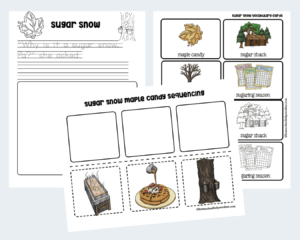
- Your students can trace, copy, and then illustrate 3 short excerpts from the book to practice their best handwriting skills using the Sugar Snow Copywork worksheets in the Sugar Snow Printable Pack
- Learn new vocabulary words like spile, strain, auger with the 12 Vocabulary Card printables in the Sugar Snow Printable Pack
- After your kids are familiar with the sugarmaking process (to make maple syrup) let them put the Sugar Snow Sequencing Cards in the correct order. There’s an easier version and a harder version for different skill levels.
Practical and Fine Arts
Fine Arts

Currier and Ives created lithographs of many events and popular topics from 1834 to 1907. This one is titled American Forest Scene: Sugar Mapling from 1872. To view a larger copy of it, click to see it here at WikiArt.
Scott Joplin (2868 -1917) was known as the “King of Ragtime” and his composition, Maple Leaf Rag, was a huge success and created the musical movement known as Ragtime, which later evolved into Jazz. You can listen to a rendition of his song, Maple Leaf Rag, here with Dario Ronchi.
Practical Arts
- Make Maple Sugar Candy with one of these recipes: Science Buddies or Laura’s Prairie House
- Have a taste test between real maple syrup and the cheaper “pancake” syrup that is just colored corn syrup. Which tastes better? Which is healthier? With 6 kids, my family can’t afford the more expensive “real” maple syrup very often, so we like to make this (no corn syrup) Caramel Buttermilk Syrup. You can try it also and compare to the other two types of syrup.
Sensory
Let your kids explore with their senses while playing with this maple syrup play-dough from the Imagination Tree.
Sugar Snow Unit Study Printables Pack

More Laura Ingalls Wilder Homeschooling Printables
We also have free Laura Ingalls Wilder copywork pages and a Laura Ingalls Wilder notebooking page.

Winter Days in the Big Woods Unit Study
Don’t forget to pin this to your favorite Pinterest board so you can find it again later.
And be sure to follow Homeschool Helper Online on Pinterest for more affordable homeschooling resources!