Why Study Geography?
Why take the time to teach geography to your kids when we all have GPS on our phones? Here are some valid reasons to make sure your kids can read a map and have a basic idea of where things are in the world.
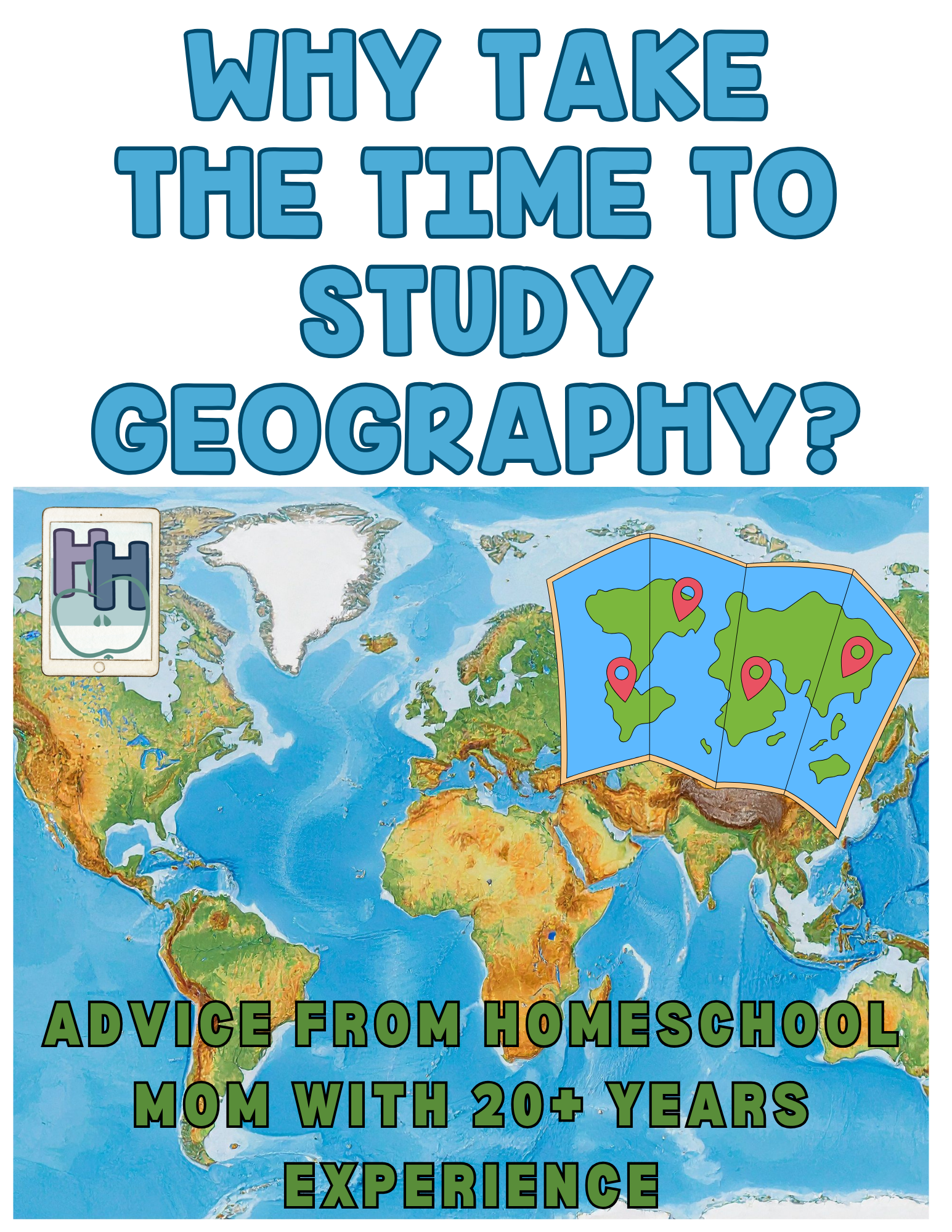
Here are four important reasons for your kids to study geography, geographical terms, how to read maps and navigate their local area, and have some general geographical background knowledge.
Home Town Navigation
We live outside of a mid-sized college town and I thought my oldest had paid enough attention while we drove around town doing errands that she would be able to get around by herself once she got her driver’s license.
I found out a few months later that she only knew how to get to a couple of different places, and she’d drive to one place on the other side of town, in order to get to where she was doing because she only knew how to get from Point A to Point B and Point B to Point C. She didn’t know how to get directly from A to C. Or how to go anywhere using street names.
We made it a point to use street names often and to discuss how to get places in town and how to go to other towns as we were driving around after that to teach our next kids how to navigate around their hometown and local area.
2. Meaningful General Background Knowledge
I remember having to memorize all of the US state capitols when I was in 7th grade. Do I remember them all now? No, of course not. Do I remember the ones I’ve been to, or learned more about than just its name? Yes.
I didn’t ever make my kids memorize geography facts, but I did want them to have a basic idea of where things were in the world. For example, I didn’t think they needed to know the exact location of every single countries in the world, but I wanted them to at least know what continent it was on, or basic geographical location, like in the African desert, on an island in the Pacific Ocean. Just general locations and knowledge.
Before we got married, my husband sold a car to someone who lived smack dab in the middle of the North American continent. That guy told my husband he was going to drive the car to Hawaii. When my husband pointed out that Hawaii was an island in the Pacific Ocean, the guy replied, “Yeah, I know. I’m going to drive it on the Golden Gate bridge. It goes from California to Hawaii.”
You don’t want your kids to be remembered for thirty years as the Golden Gate bridge guy.
3. Basic Geographical Vocabulary
Along with learning basic geographical information about your local area, country, and world, it’s a good idea to have a basic understanding of geography related vocabulary.
For example, you probably don’t need to know that an adret is the sunny, warm side of mountain. Or that a snout is the lowermost part of a glacier, always advancing and retreating.
But it is pretty helpful to know what longitude and latitude are and how they are used in GPS.
It’s also good to know the difference in a creek, brook, or river; or to know where in the world is the Ring of Fire.
4. Ability to Read Maps
I know my teens still rely much too heavily upon their phones to give them directions, even though we encourage them to learn how to get where they are going using road names and landmarks.
Relying on the GPS on a smartphone can be a bad idea, since there might not always be cellular service, especially if you are in a rural area. If you lose service and are lost, you need to know how a paper map works (and to have one in your vehicle) even if you think it’s a boomer thing to use a paper map. (Learning how to refold a paper map is a whole other subject LOL)
Recently, a teenage girl in our area was abducted and law enforcement was asking all local citizens to assist with her search and rescue in a nearby national wildlife area covering thousands of acres. Being able to read a topographical map helped volunteers know where they needed to go and to prevent themselves from also being lost.
BTW: Trail Life and Civil Air Patrol will both teach your children how to read different kinds of maps, as well as teaching basic first aid and search and rescue skills (among many other useful topics).
Resources for Teaching Geography
If your students are wanting to learn more about geography, check out these great resources:


Don’t forget to pin this to your favorite Pinterest board so you can find it again later.
And be sure to follow Homeschool Helper Online on Pinterest for 1000s more free homeschooling resources!
