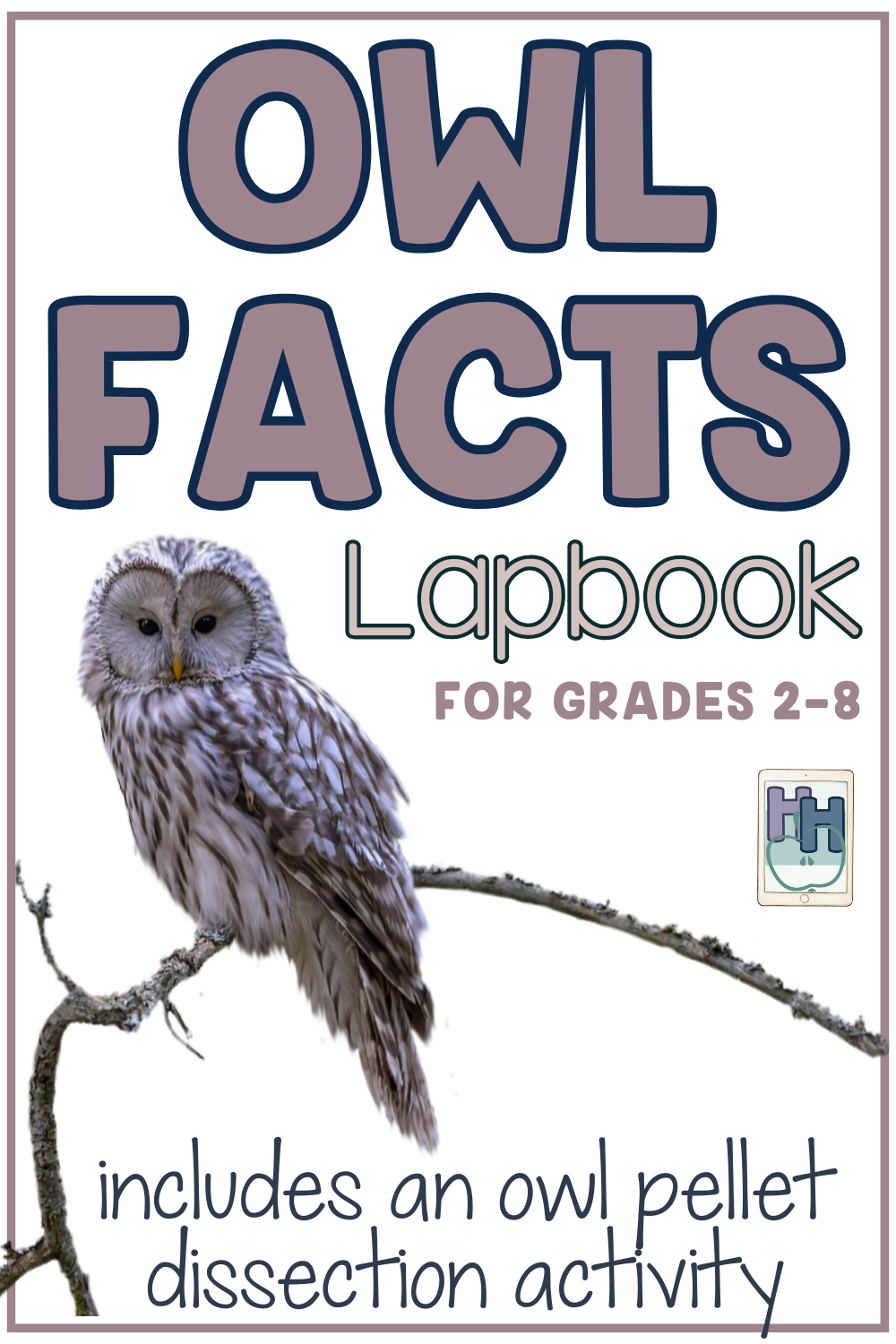
Owl Facts Lapbook for Elementary & Middle School
What is a raptor, and are owls raptors too? What do owls eat? How do owls hunt? Learn the answer to these questions and more in this Nature Study owl lapbook.

This great Owl Lapbook Learning Folder STEM activity contains fifteen different booklets plus one hands-on activity to help your 2nd to 8th-grade students learn more about this nocturnal bird of prey.
Not sure what a lapbook is? Find out here.
Some links in this post may be affiliate links for products that I’m using or have tried in the past and recommend. This means that if you click on them, I may make a tiny commission, at no extra cost to you. For more info, check our privacy policy.
Here are the resources used in the Owl Lapbook:
Books & Hands-On Resources
Owls by Gail Gibbons
Birdwatching Books for Kids: Looking for Owls by Sue Breeden
Owl Pellet Dissection Kit with Tools & Chart (We get the “large” sized ones)
Online Resources
Are Owls Raptors? and Other Owl Facts
What are owl pellets? (with bone guide)
Owl Anatomy (with labeled graphics)
An owl’s Skeletal System and How their bones help them
Owl Sounds (this page is for the barred owl; type in the owl species you want to hear in the search bar)
Videos
What are Owl Pellets? (SciShow Kids)
Optional Resources
The Book of North American Owls by Helen R. Sattler (for grades 4 to 8)
The Barn Owls by Tony Johnston ( a living science book about the life cycle of owls)
A Little Owl by Rosalee Wren (a board book for your younger kids; goes through the life in the life of an owl)
You may want to also use some of the many resources listed on our Owls Notebooking Nature Study post.
All of the books for this unit are in my book list: “Owls and Raptors” in my Amazon affiliate store (the cost to you is the same and I make a very small commission to help offset the cost of running this site)
If this is your first time completing a lapbook, read this first to learn how to fold your folders to create the lapbook base.
Owl Lapbook Mini-book Activities
Read the book Owls by Gail Gibbons. Use the other listed resources to help you answer the questions in the mini-books.
- Characteristics of Raptors: What 5 characteristics do raptors have?
- What is a Raptor? Define raptors in the mini-book. What other animals are raptors?
- Sizes: Answer the questions about the different sizes of owls in the flap book. Which is the largest owl; and which is the smallest? How big are they?
- Owl Families: Owls are in the Strigiformes order in two different families, the Strigidae and Tytonidae. Each family has two main types (or common names) of owls. (hint: one family has two common names that both start with the letter T, and the other family has two common names that both start with the letter B). Owls are mainly sorted into the two families by their face shape, their sternum, and their feet.
- Varieties: Learn the names, sizes and habitats of sixteen different species of owls from both the Strigidae and Tytonidae families.
- Facts About Owls: Answer the questions about owls and their vision, when they like to hunt, how they can see what is behind them, and how they hear.
- Hunting their Prey: Use the layered book to write about how owls hunt their prey using their talons and vision and how even their bone structure and feathers help them hunt. Finally, describe how they eat their prey.
- Communication: List some of the sounds owls make along with their meanings. Use the Cornell Lab’s All About Birds site or look up on specific species on youtube.
- Owl Anatomy: Find and label the following anatomical features:
- claw
- toe
- abdomen
- undertail coverts
- tail
- secondary coverts
- primary feathers
- secondary feathers
- collar
- back
- facial disc
- eyebrow
- chin
- bill
- throat
- breast
- ear-tuft
- iris
- belly
- primary coverts
- flanks
- Pellet: Dissect an owl pellet and record your findings in the shutter book with an extra flap. An owl pellet is the non-digested parts of its dinner that it “burps” back up. (It’s not poop) The commercial owl pellets are sanitized, but you may still want to wear rubber gloves while handling the pellet and bones. We like to get the large size pellet which generally has at least 100 bones in it. Be sure to also take pictures of your findings. Use the enclosed bones guide that came with your pellet to identify what animal the owl ate, or use this printable chart.
- Nesting: Write about the places owls like to nest in the mini book.
- Parenting and Breeding: Describe the mating and breeding habits of owls in the flap book. For example, do owl pairs mate for life? Which partner sits on the eggs? Who cares for the owlets? How do they care for them?
- Owl Life Cycle: Use the included pictures to show the life cycle of an owl, or draw your own pictures. The life stages are: hatching egg, newborn, chick, owlet, fledgling, and adult.
- Owlets: In the matchbook, write specifically about the life of owlets, what they do; how they eat, etc.
- Threats to Owls: Write about the causes of the decrease in the population of owls in the square mini book. Who or what are the main threats to owls? Are they at the top of their food chain?
Hands-on Extension Activity
Build an owl house to put out in your yard to encourage some owls to make your yard their home. Pick one of the owl house plans from this site.
Get Your Owl Lapbook in the HHO Shop
-

 Product on saleOwl Facts Lapbook for 2nd – 8th GradesOriginal price was: $9.00.$6.00Current price is: $6.00.


More Nature Study Resources for Your Homeschool


Don’t forget to pin this to your favorite Pinterest board so you can find it again later.
And be sure to follow Homeschool Helper Online on Pinterest for 1000s more free homeschooling resources!