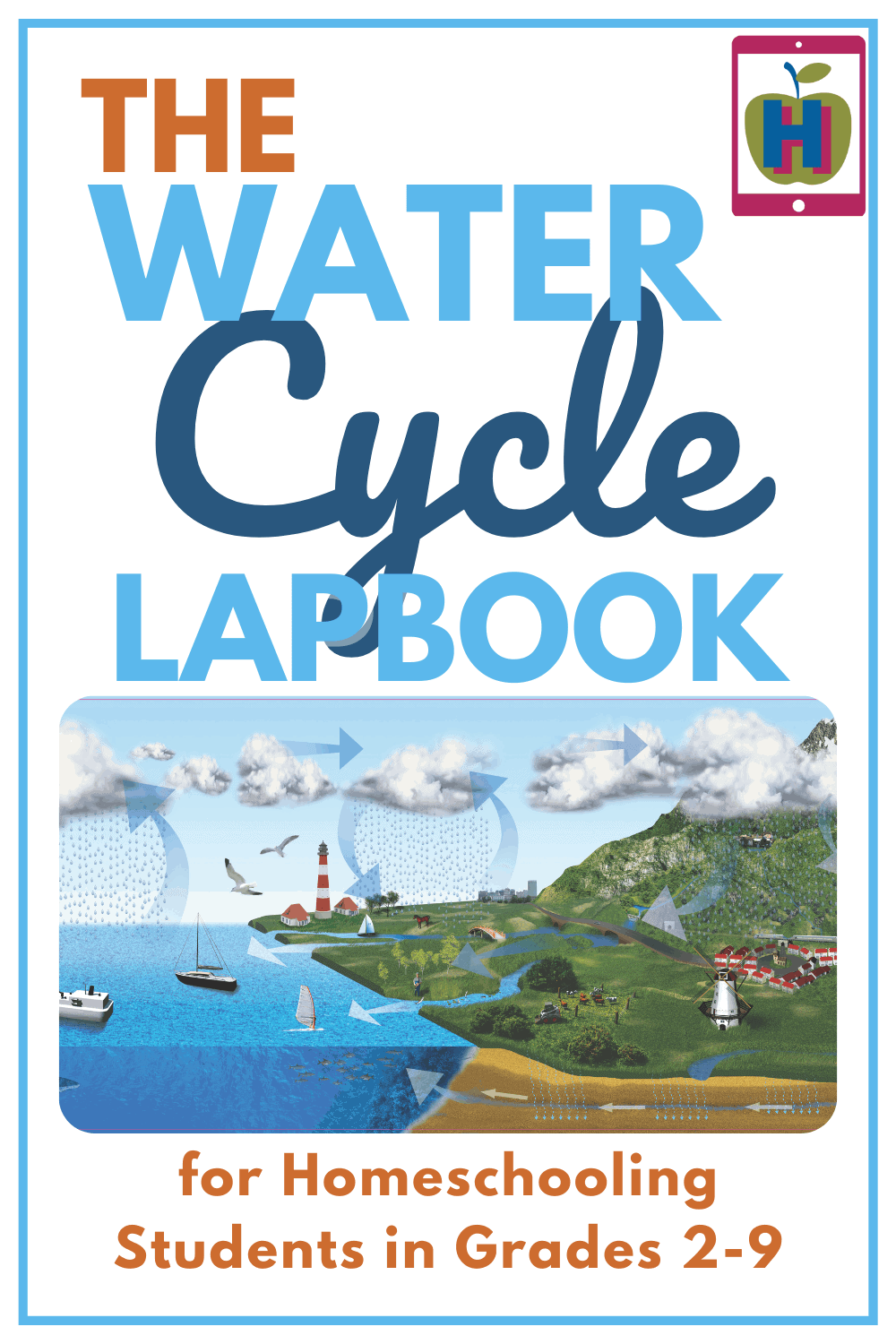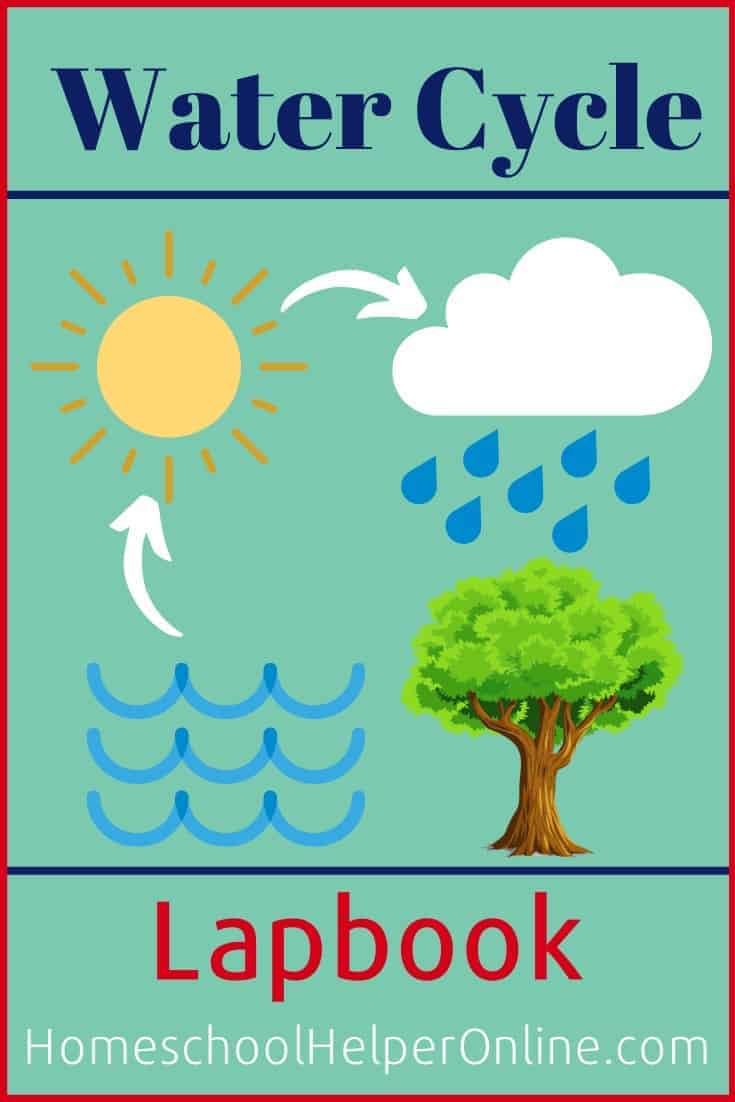
Water Cycle Lapbook for Elementary & Middle School Students
Teach your kids all about the water cycle in this free Water Cycle Lapbook.

With this science unit, your student will learn vocabulary words like hydrologic, answer questions, and complete hands on activities and experiments about Earth’s water cycle.
Some links in this post may be affiliate links. This means that if you click on them, I may make a tiny commission, at no extra cost to you. For more info, check our privacy policy.
Resources used in the Water Cycle Lapbook:
Online sources:
USGS Water Cycle (easier version)
Choose 2 or 3 of these informational books:
For your younger kids to learn alongside their siblings completing the lapbook:
The Snowflake: A Water Cycle Story by Neil Waldman
Drop: An Adventure through the Water Cycle by Emily Kate Moon
For your kids completing the lapbook, in order of difficulty:
The Water Cycle at Work (Water In Our World) by Rebecca Jean Olien
The Magic School Bus Wet All Over: A Book About The Water Cycle by Pat Relf
Drip Drop: Water’s Journey (At Home With Science) by Eve Stwertka
A Drop Of Water: A Book of Science and Wonder by Walter Wick
And just for fun:
The Water Cycle Coloring Book (Dover Nature Coloring Book) by Michael Dutton

Water Cycle Lapbook Activities to Complete:
- Vocabulary – Define the vocabulary words in the fan booklet.
- vapor
- infiltration
- transport
- hydrologic
- conservation
2. Complete this Thirstin’s Water Cycle Activity and record the results in your lab book.
3. Evaporation/Transpiration – In your tri-fold mini-book, explain what each process is. How are they different? How are they the same?
4. Hands-on Experiment:
Put a pot of water on the stove and bring it to a boil. Observe. What’s going on? Why? Record your experiment in your lab book.
5. Condensation – Explain what condensation is in the mini-book. What forms as a result of condensation?
6. Hands-on Experiment:
You’ll need 4 identical glasses, ice water, fridge, and freezer. Use one glass as a control glass by setting it on the table. Place one glass in the fridge and one in the freezer. Fill the last glass with ice water.
After 10 minutes take the glasses from the freezer and fridge, place them on the table next to the other glasses.
What do you see? Feel the glasses, are they wet? Where did the water come from? Is it necessary for the glass to be filled with water to get water on the outside? Record your observations in your lab book.
7. Precipitation – What is precipitation? How is precipitation formed? What are the benefits? Answer the questions in the precipitation booklet.
Hands-on Precipitation Experiment:
You’ll need – a tea kettle containing 1 to 2 glasses of water, a small saucepan, cold water with ice cubes, stove, pot holders, small bowl.
Procedure – bring water in tea kettle to boil. Place ice water in sauce pan.
When steam is rising from kettle, hold pan of water over spout so steam is
hitting bottom and side of pan. Make sure to have small bowl under pan to
catch your rain and use pot holders so you don’t get burned.
What is going on? Why? Record your observations in your lapbook.
9. Aquifer – Draw an example of an aquifer on the front cover of the aquifer book and answer these questions inside the book. What is an aquifer? What is the purpose of an aquifer? Name some types of aquifers.
10. Hands-on: Select a type of aquifer and build a model of that kind of aquifer using the materials of your choice. Alternatively, complete this groundwater experiment. Then, see which materials clean the water best with this Clean Water Experiment.
11. Water Cycle Word Search – Complete the word search found with the Water Cycle Notebooking pages.
12. Ways We Use Water – List some ways that we use water inside each circle.
13. Water Facts – Find the answers to these questions.
- How much of the earth’s surface is covered with water?
- How much of the earth’s water can be used as drinking water?
- When was the Safe Drinking Water Act passed?
- What temperature does water boil?
- What temperature does water freeze?
- How much water does it take to brush your teeth, shower, and flush the toilet?
- How much of your body is made up of water?
Download your copy of the Water Cycle Lapbook from the Free Resource Library. Look under Lapbooks
Not a member of the HHO Squad yet? Scroll down to the light blue box at the bottom to sign up and get immediate access to the Free Resource Library.
Related Water Cycle Pages:
Be sure to pin this post to your favorite Pinterest board so you can find it again later.
And be sure to follow Homeschool Helper Online on Pinterest for 1000s more free homeschooling resources!