United States Flag Lapbook for Elementary Students
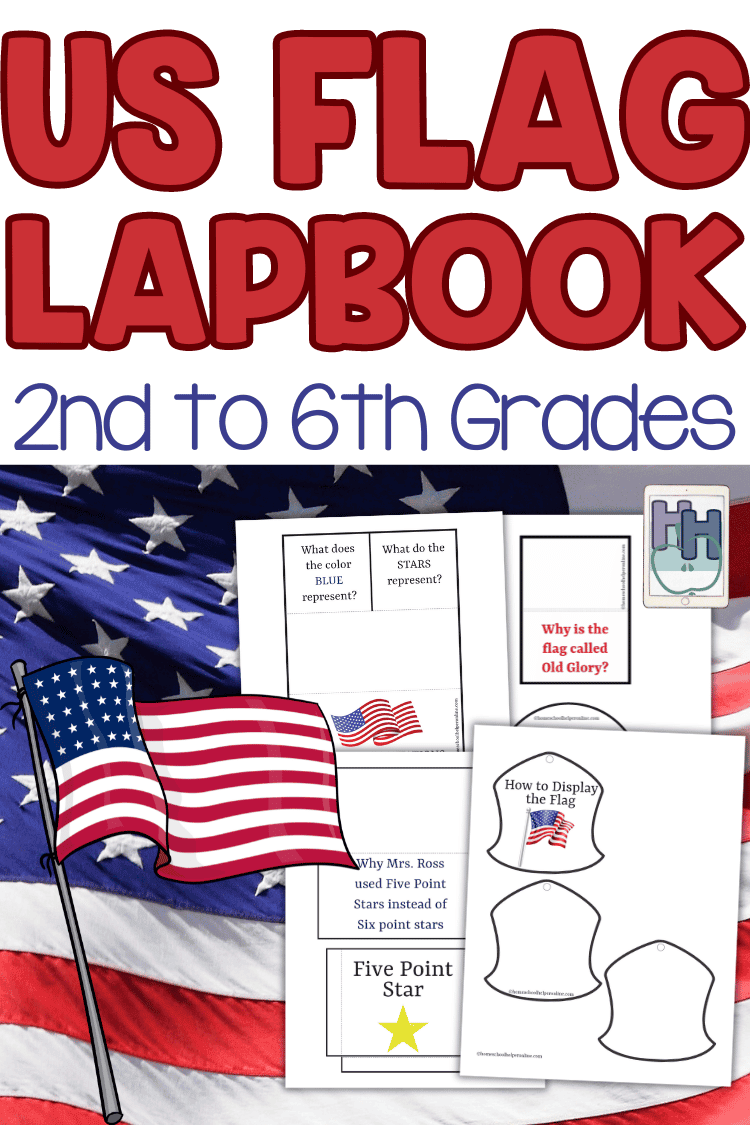
Your children will learn about the history of the American flag in this United States Flag lapbook for elementary students.

How did the United States flag come into being? Why does it look the way it does? Who made the first flag? You will learn the answer to all of these questions and more in this United States Flag Lapbook.
Not sure what a lapbook is? Find out here.
Websites to Use as Research for your United States Flag Lapbook:
- Betsy Ross at U.S. History.org (this is an older site, but it has great information!)
- Folding the Flag at U.S. History
- Flag Rules and Regulations
Some links in this post may be affiliate links for products that I’m using or have tried in the past and recommend. This means that if you click on them, I may make a tiny commission, at no extra cost to you. For more info, check our privacy policy.
Library List for Your American Flag Lapbook
Pick a few of the books from the list that will best match your child’s reading (or listening) abilities.
Red, White, and Blue: The Story of the American Flag (Penguin Young Readers, Level 3) by John Herman
Our Flag (a Little Golden Book) by Carl Memling
The American Flag (A True Book: American History) by Elaine Landau
I’m Your Flag So Please Treat Me Right by Julia Cook
The United States Flag (Symbols of American Freedom) by Kristen Chang

If this is your first time making a lapbook, read through these instructions on How to Fold a Lapbook before getting started.
United States Lapbook Activities & Instructions:
American Flag Then & Now
Cut out along the solid outer lines. Fold one short edge in toward the center along the dotted line; fold the other short edge in toward the center along the dotted line. Color the original flag and the current flag. Inside, discuss what they look like and how they are different and alike.
Why Is the Flag Called Old Glory?
Cut out along the solid outer lines. Fold in half along the center dotted line with the text to the outside. Write the answer under the flap. The answer can be found at Betsy Ross’ FAQ (at the bottom of the page)
Symbols and Colors of the Flag Representations
Cut out along the solid outer lines. Shutter-fold the short edges in toward the center along the dotted lines with the text on the outside. Fold the entire unit in half along the dotted line. Open and cut along the short solid lines to form four flaps. Refold. Write the answers to the questions under each flap. The answers can be found at Betsy Ross’ FAQ
Why are the stars in a circle on the original Betsy Ross Flag?
Cut out along the solid outer lines. Fold down along the dotted line. Then fold along the double dotted line so that the text is to the outside. Write the answer under the flap. The answer can be found at Betsy Ross’ FAQ
Five-Point Star
Cut out along the solid outer lines. Fold the narrow flaps in along the dotted lines. Glue the flaps to the folder to form a pocket. Cut out a five-point star from a separate piece of paper and put it in your envelope.
Betsy Ross
Cut out along the solid outer lines. Put them in order. Put the title page on top. Staple them at the bottom. Glue back to the folder. Answer the question that is on each flap. The answers can be found at Betsy Ross: Her Life
Five Point or Six Point Star Story
Cut out along the solid outer lines. Fold in half along the center dotted line with the text to the outside. Write a brief summary of the story of why Mrs. Ross used a five-point star instead of a six point star.
How to Display the Flag
(print 2 copies of the second page of this shape) – Cut out all shapes along the solid outer lines and punch holes in each. Stack them up with the title page on top. Fasten them together with a brass fastener. They will now be like a fan. Record as many of the ways to display the flag as you want. The 14 different ways to display the flag can be found at Flag Rules and Regulations
Additional Mini-Books in Updated Version
Stars and Stripes Forever
Cut out along the solid outer lines. Fold into fourths along the dotted lines. so that the cover in on the outside. Cut along the solid lines between the questions to create flaps.
The song, Stars and Stripes Forever, is a march written by John Phillip Sousa on Christmas Day, 1896. However, it was 90 years before it was designated as the official march of the United States. Listen to the United States Army Field Band perform it.
Learn more about this song with these resources:
Stars and Stripes Forever Music History OR listen to the podcast Classics for Kids both of these contain the same basic info.
This song has been used in many cartoons, children’s shows, and made into many parodies. Just for fun, watch the Muppets version.
Look under “Variations and Uses” to answer the rest of the questions in the mini-book.
Pledge of Allegiance
Cut along solid lines. Fold on dotted line in half so writing is to the outside. Fold each side in so writing is on the outside. Answer the questions inside each flap.
The pledge is a statement of loyalty to the United States. All school children learned the pledge in early elementary, and stood to recite it at the beginning of each school day.
Use this information from Ben’s Guide to answer the questions in the mini-book.
Use the printable Pledge of Allegiance poster to help your kids learn and memorize the United States’ Pledge of Allegiance to the Flag (found in the Lapbook product).
Flag Code for Order of Flags
Cut along the outer edges. Glue the tab of the smaller section to the end of the larger section. Fold with an accordion-style fan fold. Inside, write the order of precedence for flags (which ones are higher).
If you have more than one flag flying in a location, the flags must be ordered correctly in terms of height. List the order in which flags are to be flown. Use the “order of precedence of flags in the US” to help you.
Star Spangled Banner Flag
Who sewed the flag that flew on the battlefield during the War of 1812, that inspired Francis Scott Key to pen the poem that would later become our National Anthem? What did that flag look like? How big was it? At which military fort was it flown? Use this Smithsonian article for your research.
Watch this video of the full poem (originally titled “Defence of Fort M’Henry“) that was set to a popular English tune and was originally sung at a much faster tempo. You can read the original words here, including an explanation for the controversial phrase “hireling and slave” which is referring to hired soldiers and the King’s vassals fighting for the British (which was common at the time), not to African slaves.
Cut out all along solid outer lines. Fold all sides under on dotted lines. Fold the top under and flip it over. “Who sewed…?” should be on the top. Inside, answer the questions. Cut out the picture and glue it inside in the middle.
Displaying at Half Mast (Half Staff)
Name 4 instances when the flag can be flown at half-mast. Who can authorize the flag to be flown thus? Use these flag rules to help you answer.
The Thirteen Original Colonies
Cut out the triangle mini-book along the solid outer lines and fold on the dotted lines. The graphic should be on the outside.
The U.S. Flag has 13 red and white stripes that symbolize the original thirteen colonies that declared independence from Great Britain. Write the names of those colonies in the triangle mini-book.
Get the updated version of this lapbook in the HHO Shop, or download the older, original version for free from the Free Resource Library below.


Download your copy of the original United States Flag Lapbook from the Free Resource Library. Look under Lapbooks
Not a member of the HHO Squad yet? Scroll down to the light blue box at the bottom to sign up and get immediate access to the Free Resource Library.
Related Pages:
U.S. Flag Unit Study
Flag Notebooking Page
Be sure to pin this post to your favorite Pinterest board so you can find it again later.
And be sure to follow Homeschool Helper Online on Pinterest for 1000s more free and affordable homeschooling resources!