Poetry for Children Lapbook for Elementary Students
This multi-subject Elementary Poetry lapbook has many unique templates and activities based on many famous children’s poems.

Students will learn about many different general knowledge concepts such as the parts of a tooth, baseball stats, and the parts of speech as they read poetry from many famous poets.
Not sure what a lapbook is? Find out here.
This huge poetry lapbook for elementary students is a wonderful multi-subject study that includes science, language arts, geography, music, math, and sports and will take around 20 to 30 school days to complete.
Some links in this post may be affiliate links for products that I’m using or have tried in the past and recommend. This means that if you click on them, I may make a tiny commission, at no extra cost to you. For more info, check our privacy policy.
Here are the resources used in the Poetry Lapbook:
Poetry Speaks to Children edited by Elise Paschen Note: this is a book and CD set, so that your kids can hear the poetry read, many by the poet themselves. You can also check out the audiobook (for free for an hour) at OpenLibrary.
Where the Sidewalk Ends by Shel Silverstein
A Good Children’s Dictionary, such as the Children’s Oxford Dictionary
There are twenty different activity booklets in this Poetry learning folder for 2nd to 6th grades.
If this is your first time completing a lapbook, read this first to learn how to fold your folders to create the lapbook base.
Elementary Poetry Lapbook Activities:
“The Quarrel” by Maxine Kumin
Learn about fireflies and complete the lightbulb shaped book.
Complete the lift the flap book about lightning bugs.
“The Adventures of Isabel” by Ogden Nash
Write the definitions to the vocabulary words under the flaps.
In the cross fold booklet, draw pictures of the “creatures” Isabel meets and indicate whether they are real or imaginary.
“The Dentist and the Crocodile” by Roald Dahl
Learn about teeth and label the parts of a tooth.
In the Tooth Fairy Rhyme, fill in the blank with rhyming money words
Learn about the differences and similarities between alligators and crocodiles. Use the VENN diagram to organize the information.
Alligators and Crocodiles by Gail Gibbons
Wild Kratts: Alligators vs. Crocodiles
“The Crocodile’s Toothache” by Shel Silverstein
Compare this poem to the previous poem. In the alligator shaped book, write which poem you prefer and why.
“Jabberwocky” by Lewis Carroll
Find all the nonsense words in the poem and determine which part of speech they are or use the form in the Lapbook to complete the “silly story” like a grammar ad-lib.
Write your own poem by replacing the nonsense words in the poem with real words.
Learn about portmanteau (a word or mopheme–part of a word– whose meaning is derived from a blending of two or more distinct words. For example, smog is from fog and smoke). Create a list of the portmanteau words from the original Jabberwocky poem, then make up your own portmanteau word list.
“The Negro Speaks of Rivers” by Langston Hughes
Use the Rivers fan booklet to list the rivers mentioned in the poem. Be sure to also list the country and continent in which they are found, as well as some interesting facts about each river. Find each river on a map.
Langston Hughes is considered one of the leaders of the Harlem Renaissance with his “jazz poetry”. Learn about the Harlem Renaissance. Here’s a list of famous artists from that time period. Use the shutter fold book to write examples of musicians and writers and to define the Harlem Renaissance.
Bonus Poem: Where I’m From by George Ella Lyon. Use the Where I’m From template to fill in the blanks on the “Where I’m From” booklet to create your own poem, or use the remix page at Notre Dame to auto generate your own version of Where I’m From by answering the questions on the form.
“The Question” by Karla Kuskin
Take a survey and fill in the bar graph with answers after asking friends and family what they want/wanted to be when they grow/grew up.
In the circle fold book, write about what you want to be when you grow up and whether or not you think your dreams are realistic.
“Casey at the Bat” by Ernest L. Thayer
Describe each of the characters in the poem on the baseball mini book.
Play Baseball math and learn about batting averages.
Average can mean common, ordinary, or even dull. But stick the word batting in front of it and average can mean exciting, talented, or even superstar. Why? Because batting averages let us judge how good a hitter is at the plate. A batting average is a ratio. It compares the number of hits a player gets to the number of chances he had.Say you are batting for the Baltimore Orioles. You step up to the plate for the 60th time this season. Here comes the pitch… home run! It’s your 20th hit of the year. What’s your batting average? To find out, divide the number of hits by the number of at-bats: 20 hits ÷ 60 at-bats = .300 The answer is another way of writing 30 percent. It’s the same as 30 out of 100, or 30/100. If you reduce the fraction, you get 3/10. That means you hit safely in 3 out of every 10 at-bats! Here’s an example of a weaker average: 50 hits ÷ 250 at-bats = .200 A .200 average is 20% or 2 hits out of every 10 at-bats. With 3 hits out of 10 at-bats, the batting average jumps to an impressive .300.
Explore the science of baseball and read Abbott & Costello’s “Who’s on First?” skit.
Read “Casey’s Revenge” by Grantland Rice
Design a baseball card for Casey.
“Smart” by Shel Silverstein
Calculate how much money the boy lost each time.
Answer the questions about the poem.
You Are the Poet
In the final booklet, write your own poem. If you have trouble, try using some of these poetry worksheets for inspiration.
This updated Poetry Lapbook is available as a product in the Homeschool Helper Online Shop at a very affordable price


OR you can download the older version of the Poetry Lapbook from the Free Resource Library. Look under Lapbooks
Not a member of the HHO Squad yet? Scroll down to the light blue box at the bottom to sign up and get immediate access to the Free Resource Library.
More Poetry Resources
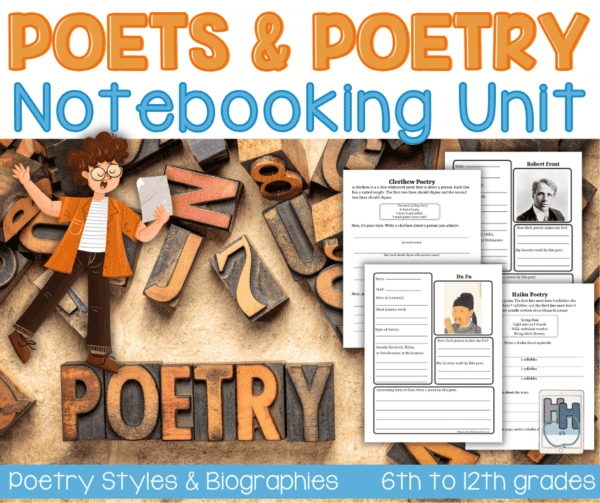
Don’t forget to pin this to your favorite Pinterest board so you can find it again later.
And be sure to follow Homeschool Helper Online on Pinterest for 1000s more free homeschooling resources!
