“My Community Helpers” Preschool & Kindergarten Unit Study
This Community Helpers Preschool & Kindergarten Unit Study will help your students learn about their family and the community in which they live, plus many of the occupations that help to create a thriving community.

Your students will explore different professions of Emergency Helpers like Police Officers, Firefighters, and 911 Operators; Medical Helpers like Doctors, Nurses, Dentists, and Paramedics; Community Helpers like Mail Carriers and City Utility Workers through a variety of hands-on community helpers activities.
Some links in this post may be affiliate links. This means that if you click on them, I may make a tiny commission, at no extra cost to you. For more info, check our privacy policy.
If you search your local library (or even on Amazon), for books about Community Helpers, most of the books are dull non-fiction books that your kids won’t like. I know my kids groan if I pull out a “boring” book with a title like, What is a Firefighter? Do your kids do that too?
So, as much as possible, I selected living books that tell a story, but still convey the facts needed as your students go through this Community Workers Preschool & Kindergarten Unit Study.
In addition to the living book recommendations, I’ve gathered family-friendly videos and online resources for you and your students to use.
Finally, there are multiple Community Helpers Activities for each profession in this Unit Study.
This preschool/kindergarten unit study about community workers uses several books by Richard Scarry as well as several books from the Little Golden Books collection. You can find most Richard Scarry books at your local library, or check Open Library for free e-books. Little Golden books are very inexpensive and make a wonderful home library set to pass down to grandchildren.
The Meet the Helpers videos used in the unit study are based on Mr. Rogers’ advice to children to “Look for the helpers” when something scary is happening.
At the very bottom of this post, check out the Fun Extras listed to help you and your students have the best time studying the Community Helpers in your neighborhood.
Families & Community Helpers Preschool & Kindergarten Lessons
Living Books for Families & Communities Lessons 1 to 3
- This is My Family (A Little Critter Book) by Mercer Mayer
- Richard Scarry’s What Do People Do All Day? by Richard Scarry (if you can’t find a copy at your library, view the ebook here for free)
- Whose Hat Is This?: A Look at Hats Workers Wear – Hard, Tall, and Shiny (Whose Is It?: Community Workers) by Sharon Katz Cooper
- Whose Tools Are These?: A Look at Tools Workers Use – Big, Sharp, and Smooth (Whose Is It?: Community Workers) by Sharon Katz Cooper
- Clothesline Clues to Jobs People Do by Kathryn Heling
- Whose Hands Are These?: A Community Helper Guessing Book by Miranda Paul
- Pig Pig Gets a Job by David McPhail (OOP, but the link goes to a free e-book on Open Library)
Online Resources for Communities & Families
Classic Sesame Street “People in Your Neighborhood” songs:
- Grocer and Doctor (Man)
- Teachers and Bodega owners
- Firefighter and Mail Carrier and an updated version
- Motorman and Telephone Repair Man
- Doctor (woman) and Astronaut
- Crossing Guard and Waiter
- Pilot and Nurse
- Dentist and Bus Driver
- Florist and Electrician
The Professions Song by Kids Learning Songs
The Alphabet Occupations Song by Jack Hartmann
Jobs in Your Neighborhood with Patty Shukla
Communities & Families Activities
Lesson 1: Families
Read This is My Family together. Talk with your child about what makes a family (Love) and how families can be of different sizes and live close or far away from each other. We all have a role in our families and we have to work together to create a life.
Help your child complete a simple family tree printable.
Next, talk about where you live. Help your child learn their full street address. Use the “My Address” pages in the Free Resource Library to help them practice. Talk to them about how all the even house numbers are on one side of the street and the odd-numbered houses are on the other side.
Lesson 2: Community
Then, take a walk or a short drive around your neighborhood. Talk about what types of houses there are; the businesses you frequent; and even any parks or places of worship in your neighborhood.
Optional activity: Recreate your neighborhood with wooden blocks or masking tape on the floor (for roads and buildings), or even with fabric scraps. My sister likes to sew and made my kids a 3-foot by 3-foot play mat that matches our “country neighborhood”. Or use a set like this Melissa & Doug Wooden Town
Now, read the books, Richard Scarry’s What Do People Do All Day?, the Whose Hat? and Whose Tools? books, as well as the Clothesline Clues book, all listed above.
Choose two community helpers to compare and complete the Community Helpers Venn Diagram in the Free Resource Library. (Optional: Complete this activity at the end of your unit study instead)

Emergency Helpers Preschool & Kindergarten Lessons
Living Books for Emergency Helpers
- Police Officers on Patrol by Kersten Hamilton (also available as a free e-book on Open Library)
- Officer Buckle and Gloria by Peggy Rathman
- Richard Scarry’s A Day at the Police Station by Richard Scarry
- Richard Scarry’s Busiest Firefighters Ever (Little Golden Book) by Richard Scarry
- Richard Scarry’s A Day at the Fire Station by Richard Scarry
- Big Frank’s Firetruck by Leslie McGuire
- The Fire Engine Book (Little Golden Book) by Tibor Gergely
- Fireman Small – Fire Down Below by Wong Herbert Yee
- To the Rescue! (My First I Can Read) by Mercer Mayer (9-1-1)
Online Resources for Police, Firefighters, & 911 Operators
Meet the Helpers: Police
Real-Life Rescue Heroes: Police from Fisher-Price
Meet the Helpers: Firefighters
Real-Life Rescue Heroes: Firefighters from Fisher-Price
Making a Fire Escape Plan at NFPA
Sparky.org from the NFPA has a bunch of games & apps to help your kids learn about fire safety
And SparkySchoolHouse is just jam-packed with fire safety resources (lessons, videos, printables)
Meet the Helpers: 9-1-1 Operator
Police Officers & Firefighters Activities
Lesson 3 Police
First, read the three police books listed above. Then talk with your kids about what a police officer does and how he is our friend. Also talk about some of the different tools a police officer uses (a radio/walkie-talkie, handcuffs, bulletproof vest, yellow police line tape, a car or motorcycle, and a K-9 search dog).
Next, watch the police videos listed above.
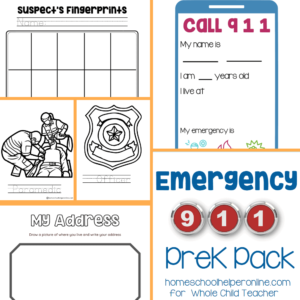
Use a washable ink pad to make fingerprints on the printable Suspect’s Fingerprints page in the Free Resource Library. The page is made like a math “ten block” to you can use it for counting, learning about sets, and addition or subtraction problems.
Finally, use a magnifying glass to look at the fingerprints. Print another copy of the Fingerprints page and make fingerprints of another person’s fingers. Discuss how nobody’s fingerprints are the same because everyone is unique.
Discuss with your children what to do if they are ever lost and can’t find a parent.
Finally, take a field trip to your local police station or sheriff’s office. They are always happy to see kids and to talk to them about their job; it just takes a simple phone call to set it up.
Lesson 4: Firefighters
Read the firefighter books and watch the firefighter videos listed above. Discuss the tools of a firefighter and how having the right tools for a job helps them do their job and keep you safe. Watch the firefighter videos listed above.
Create a fire escape plan for your house with your kids (use this printable escape plan drawing and fire safety plan from Meet the Helpers) and choose a meeting spot outside. Have a practice fire drill.
Watch the “I Spy” fire safety video on this Sparky page from the National Fire Protection Association
Visit your local fire station. They are happy to do field trip tours for groups of kids if you call ahead. Otherwise, plan to take them some cookies or other treats and visit with them for a few minutes.
Your older kids can extend this lesson by completing the Fire Safety Lapbook.
Lesson 5 Emergency Operators
Watch the 9-1-1 video listed above.
Use the 9-1-1 Script printable page in the Free Resource Library to help your children practice what to say if they need to call for help.
Read the Little Critter book, To the Rescue!, listed above. Talk to your kids about why they would ever need to dial 9-1-1. Let them practice on a fake or disconnected phone. Make sure they understand what would happen if they dialed Emergency when there wasn’t an actual emergency (the police will show up to find out if someone needs help).

Medical Helpers Preschool & Kindergarten Lessons
Living Books about Doctors, Nurses, Dentists, & Paramedics
- Calling Doctor Amelia Bedelia by Herman Parish
- Doctor Dan the Bandage Man (Little Golden Book) by Helen Gaspard
- Nurse Nancy (Little Golden Book) by Kathryn Jackson
- The Berenstain Bears Visit the Dentist by Stan & Jan Berenstain
- Just Going to the Dentist (Little Critter) by Mercer Mayer
- The Tooth Book by Dr. Seuss/ Theo LeSeig
- Doctor De Soto by William Steig
Online Resources about Medical Helpers
Real-Life Rescue Heroes: Doctor
A virtual field trip to the pediatrician by KidsVision
Meet the Helpers: Doctor
A Day in the Life of a School Nurse by Johnson & Johnson
Meet the Helpers: Paramedic or EMT
Real-Life Rescue Heroes: Paramedic by Fisher-Price
A Child’s Visit to the Dentist from Dr. Boyk’s office
Visiting the Dentist by SciShowKids
Dental Facts at St John’s Kids to help you answer your kids’ questions
Activities for Doctors, Nurses, Dentists, and Paramedics
Lesson 6 Doctors & Nurses
Read the doctor and nurse books and watch the doctor and nurse videos listed above.
Let your kids do a pretend play of a doctor’s office. You can find play doctor kits at most stores that carry toys. This kit has items to play doctor or dentist plus a real stethoscope! Or you can let them use a few band-aids (I’m pretty sure all kids are obsessed with bandages LOL) and some self-adhesive wrap (aka “vet wrap”)
Make an art collage using materials you would find in a doctor’s office. Do it in sets of 5 to practice skip counting. For example, use 5 band-aids, 10 gauze squares, 15 cotton swabs, and 20 cotton balls.
Lesson 7 Paramedics
Watch the paramedic videos listed above.
After watching this first aid video and this other first aid video on how to clean a cut with soap and water, do this bread and germs experiment to help your kids understand how an infection can grow if we leave a cut or scrape dirty.
Lesson 8 Dentists
Let your kids do some pretend play of going to the dentist after watching the dentist videos and reading the dentist books listed above. Check out these pretend play suggestions from the Empowered Provider. Some doctor’s play kits, like this one, come with dental tools as well. Or, if you already have a doctor kit, grab this nice dentist play set.
Show your kids how bad soda is for their teeth while also teaching them how toothpaste helps to get their teeth clean. Place 1 hard-boiled egg for each child into a cup of dark soda (cola, root beer, or Dr. Pepper). You’ll need to use while eggs for this and make sure the soda completely covers the egg. Wait 24 hours and then take the eggs out of the soda. The eggs will have turned brown.
Next, let your kids try to clean the eggs with a toothbrush and water. They probably won’t be able to get all of the brown off the egg. Next, let them clean their egg with toothpaste and a toothbrush. Most of the brown should come off, but if they compare it to an egg that wasn’t soaked in soda, they’ll see that even after brushing, their egg still isn’t as white as it was before.
Finally, let your kids pretend to be a dentist with these play-doh teeth set or use this DIY version from Fantastic Fun & Learning.


Community Helpers Preschool & Kindergarten Lessons
Living Books about Mail Carriers and Utility Workers
The Jolly Postman: Or Other People’s Letters by Janet and Allan Ahlberg
Mr. Griggs’ Work by Cynthia Rylant (a classic one that you’ll want for your home library)
Seven Little Postmen (Little Golden Books) by Margaret Wise Brown
The Post Office Book: Mail and How It Moves by Gail Gibbons
Where Is My Daddy?: The Story Of A Lineman by Joe Peterson
Oscar and the Bird: A Book about Electricity by Geoff Waring
My Lineman, My Daddy, My Hero by Kelly Suzanne Pennel
Keeping the City Going by Brian Floca This book is actually about the first year of the pandemic in NYC, but it does a nice job of telling about the essential city workers.
If You Were a Garbage Truck or Other Big-Wheeled Worker! by Diane Ohanosian
Mike Mulligan and his Steam Shovel by Virginia Lee Burton
Online Resources about Mail Carriers and City Workers
Virtual Field Trip to the Post Office from South Florida PBS
Rescue Heroes Recycling Matters (cartoon)
Real City Heroes George the Garbage Truck
Real-Life Heroes Heavy Duty Truck Operator
Meet the Heroes: Lineman
Community Helpers Activities
Lesson 9 Mail Carriers
Read the living books and watch the videos about mail carriers and post offices listed above.
Write a letter to a friend or relative using the friendly letter printable. Show your students how to address the envelope. Then mail it from your residence or go to the post office to mail it.
Contact your local postmaster to see if they will explain how the mail system works or if they will give you a tour.
Let your kids stuff some envelopes with papers, and package up something in a used delivery box to weigh them on a scale. Explain to them how most mail is weighed and the shipping charge is calculated using the weight of the package or letter. A kitchen scale will work best for this.
Show your kids different stamps and explain what they are used for. Let them design their own stamp. If they want, they can use this stamp glue recipe to turn their designs into “real” stamps to use in their pretend play.
My sister created a simple apron for my kids to play post office; one side was blue and white with the letters USPS, and the other side was brown with UPS on it. She gave it to them along with this cute mailbox set. It was one of their favorite pretend plays.
Lesson 10 City Workers
Read the living books and watch the videos about recycling & garbage trucks and linemen listed above.
Clean and collect a few days’ worth of containers and papers from your trash and recycling. Let your kids sort the trash by paper, recyclable plastic, and glass. Show them how to take out the trash and replace a new liner in the can.
Most recycling centers are happy to give small groups a tour to explain how the items are sorted and where they go afterward. We even went on a field trip to our local landfill where they showed us how they make big holes and bury the trash, smashing it down between layers. The kids LOVED the heavy equipment but a word of caution: it really really stunk at the landfill!
Show your kids how things are recycled with this recycled paper project from YouCleverMonkey.
Work on rhyming with the Truck Rhyming Mats from Royal Baloo. These community helpers trucks (fire truck, recycling truck, etc) coordinate really well with this unit.
Where we live, our rural electric co-op does a safety presentation for kids to explain a lineman’s job and how dangerous it is to climb an electric or telephone pole. See if your city utility will give your kids a tour of the electric plant, and wastewater treatment plant, or will do a safety lesson for you and your friends.
Our city does a truck day each year where all of the different city worker trucks gather and let kids climb in and around the trucks: electric lift trucks, fire trucks, ambulances, trash trucks, snow plows, and more. Perhaps you can find an event like that near you. 🙂
Printables for your Community Helpers Unit Study

All HHO Squad members get 8 emergent literacy coloring pages for your Community Workers unit as well as the other printables listed in this unit study.
Each of the printables is available as individual downloads for free in the Free Resource Library under “Unit Studies” > Community Helpers.
Or for your convenience, you can also get the printables as a bundle in the HHO Shop. There’s the smaller Emergency 911 Preschool Pack or the complete Community Helpers Unit Study Bundle that includes ALL of the instructions, book lists, vetted resources & links PLUS the printables. And as a bonus, there are an additional 37 different professions as emergent literacy/coloring pages for a total of 45 community occupations.



Fun Extras for your study of Community Helpers
Little People Neighborhood Helpers: 5 pack or 10 pack
Community Helpers Who’s That? Game Like Guess Who? but with Community Helpers instead
Richard Scarry’s Busytown Seek and Find Game for Preschoolers
Guess in 10 Junior: Community Helpers Use clues to figure out which neighborhood helper it is. Or get this version of Guess in 10: Inspiring Professions for kids ages 6 to 99
Melissa & Doug Magnetic Dress-Up Wooden Doll: Julia or Joey or the Double Set We have the Joey set and my kids pulled it out to play with over and over.
Community Helper Dress-Up Vests
Don’t forget to pin this to your favorite Pinterest board so you can find it again later.
And be sure to follow Homeschool Helper Online on Pinterest for more affordable homeschooling resources!

